Insights
In Defense of ACH

September 2, 2026 · Chivi Capezio Crookes
ACH is so important to us: the safety of our clients’ funds that are used for important and meaningful mission work across the area.

I have been at the Foundation for almost a year now, and I have seen plenty of positive changes within our organization. The transition to ACH for all withdrawals and distributions is one of them. Of course, there’s a reason for the change. The movement of money behind the scenes takes a good chunk of our work week, and we are very aware of it. I get a tight knot in my stomach when I read a client’s email letting us know they put a check in the mail and it takes longer than four days to reach our office in Cashmere.
This is why ACH is so important to us: the safety of our clients’ funds that are used for important and meaningful mission work across the area. And maybe I can convince you of its benefits, not just for our sake at work, but for yours and your personal finances.
Let’s start at the beginning.
If you ever paid something online, received your paycheck via direct deposit, made a transfer between banks, or paid your friend for half of a meal via Venmo, you have used ACH. I’ve done those things. I knew what ACH did, but until last year, I didn’t know what it stands for, or how it worked.
ACH stands for “automated clearing house.” It is a system to transfer money electronically between financial institutions, introduced in the early 1970s as an alternative to paper checks. There has been a national standardized network since the 1990s, and about 92% of workers in the United States use the system to receive their paychecks (you know, when you give a voided check to your HR person? They are setting up direct deposit via ACH). ACH transfers can be scheduled ahead of time, and it usually takes 1-2 business days for the transaction to be completed.
ACH transfers are different than wire transfers. The wire transfer system has been around much longer, originally using telegraph wires, and it moves money almost instantaneously, but it costs more to use. The transaction fee for a wire is usually around $30, whereas ACH is usually free. Our team usually advises that six- or seven-figure transactions should happen via wire (and never before confirming the receiving bank account details via a phone call to a trusted number), and smaller transfers should use ACH.
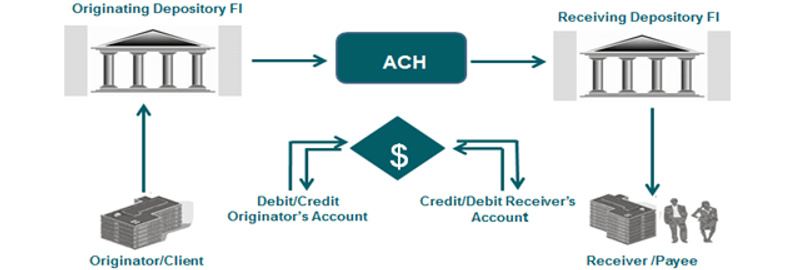
ACH works in two directions: ACH debits (when you send money out) and ACH credits (when money is sent to you). The clearing house website describes how it works in nine steps. But here are the cliff notes: The payment is initiated by an individual or organization by providing the necessary information to the ACH system (bank account details, amount, date, etc). Once the ACH operator receives the instructions, they verify the transaction and route it to the recipient’s bank. Once the transaction is cleared, the funds are debited from the sender and deposited into the designated receiving account.
Now that you know how it works, here is why it is important to us: As my colleague Sara Culp wrote on the Faith Foundation’s website, there is a rise in mail theft and check fraud that is more than anecdotal. In a report to the U.S. House of Representatives, the United States Postal Service noted that reports of high-volume mail theft from mail receptacles increased 139% between FY2019 and FY2023, driven largely by organized criminal groups targeting checks and other financial mail. In July, one of the UMCs in our episcopal area was the victim of mail theft. Their check was intercepted and fraudulently deposited in California. These crime networks continue to evolve, making electronic transfers one of the safest ways to move funds.
There are many benefits to switching your payments from paper checks to ACH. Not only within the work of the Foundation, but also in your personal life. ACH transactions are safe, fast, at low or no cost, and convenient (you can schedule payments and ensure they are made on time). So, next time you think of writing a paper check, ask yourself, “Could this be an ACH transaction?” If you are a member of your church’s Finance Committee, propose setting your church up to pay apportionments to the Conference via ACH (here’s the setup guide for PNW and AK, and here is the setup guide for OR-ID).
There are risks associated with the use of ACH transactions, but the risks can be reduced by using good judgment and following some safety tips, like only initiating ACH transactions from a secure web connection (like a private WiFi network, never a library or coffee shop), using multi-factor authentication (MFA) to access financial websites (MFA has been mandatory on the Foundation's secure statement portal since 2024), and always verifying changes to payment details with a phone call to a trusted phone number.
Our Executive Director Julia Frisbie told me a story that I am sharing with her permission: A few years ago, a small church bookkeeper received an email with an urgent request from the pastor saying that he'd changed banks, so he needed to update the information for his paychecks to be deposited. The bookkeeper made the change without calling the pastor to check if the email was real. Plot twist: it wasn't real. The email was from a scammer, and the bookkeeper didn't notice! The church sent their pastor's paycheck straight into the scammer's bank account. They never recovered the funds.
I imagine many of you know a story like the one Julia shared with me. An extreme case of fraud was just published via the UMC News Service. The key takeaway: “fraudulent actors posing as bank representatives were able to gain access by creating a false sense of crisis.” Always treat urgent requests with suspicion. When you’re not sure about something, make a phone call to a trusted number and get verbal confirmation.
ACH isn’t immune from scammers and possible theft. Unfortunately, nothing is. But we still believe it’s safer than mailing physical checks, because it doesn’t delegate the security of the transaction to mail carriers and mailboxes; it relies on the people who care most about the transaction to keep it safe. At this point, the Foundation only accepts loan payments via ACH, only sends withdrawals via ACH, and strongly prefers to receive deposits via wire or through our secure ACH portal.
And so. Make the switch if you can. Ask questions. It would give you peace of mind to know your transactions are protected, that you can track them, and schedule them.
Resources
https://www.forbes.com/advisor/banking/ach-payments/
https://faith.foundation/blog/faster-safer-ways-to-move-funds
https://achdevguide.nacha.org/how-ach-works
https://finance.yahoo.com/personal-finance/banking/article/what-is-an-ach-transfer-225206573.html